Showing posts with label reliable 4 channel CWDM Mux. Show all posts

Friday, April 21, 2017

Choose the Right SFP+ Transceivers for CWDM Mux Demux

Nowadays, CWDM technology is very popularly used as a easy and economical way to extend the network capacity by carrying several signals with different wavelengths through a signal fiber. If your network capacity is not enough for your daily use, deploying a CWDM system is an ideal choice for you. As the CWDM Mux Demux should be finally linked with the switches in a completed CWDM system, the fiber patch cable and 10G CWDM SFP+ transceiver are required to finish the whole CWDM link. Hence, this paper will mainly introduce the CWDM Mux Demux and choose the right CWDM SFP+ transceivers for the CWDM Mux Demux, which may be helpful for you to fast build a CWDM system.

CWDM Mux Demux–Key Component for CWDM System

CWDM Mux Demux is a key component for CWDM system, which should work in pairs. As an optical module, it can act as a multiplexer or demultiplexer at either end of the fiber cable. This kind of optical Mux Demux is much easier to use than the DWDM Mux Demux, but can not support the network as long as that of the DWDM Mux Demux. In general, it can offers several kinds of wavelengths, usually from 1270nm to 1610nm (20nm spacing), to support the signal transmission at lengths up to 80 km. Meanwhile, the CWDM Mux Demux can be designed with 4 channels, 8 channels, 9 channels, 16 channels and 18 channels for transmitting different amount of signals. To better know how does this kind of WDM Mux work, the following figure offers a reliable 4 channel CWDM Mux Demux duplex transmission design.

CWDM MUX DEMUX

From the figure above, we can learn that two CWDM Mux Demux are connected by a length of duplex patch cable, and they are designed with four channels multiplexing the 1470nm, 1490nm, 1510nm and 1530nm over the same fiber. To complete the transmission link, four pairs of CWDM SFP+ transceivers with 1470nm, 1490nm, 1510nm and 1530nm TX and RX should be separately inserted into the ports of these two WDM Mux Demux. When the CWDM system works, the four different signals from the left to the right will be multiplexed in the CWDM Mux, transmitted over the duplex fiber and demultiplexed in the CWDM Demux, and vice versa for the signals from the right to the left.

How to Choose the CWDM SFP+ Transceivers for CWDM Mux Demux?

As mentioned above, the CWDM SFP+ transceivers are required for building a CWDM system which should be correctly inserted into the SFP+ ports of the CWDM Mux Demux. Thereby, here offers three factors that should be taken into consideration when choosing the CWDM SFP+ transceivers for the CWDM Mux Demux.

The first factor is the working wavelengths of the CWDM SFP+ transceivers. In order to ensure the CWDM system performance, the SFP+ transceiver working wavelengths should be the same to the SFP+ ports of the CWDM Mux Demux. Just like the first figure, when the working wavelengths of the first pair of CWDM SFP+ transceivers are 1470 nm, the first ports of the two CWDM Mux Demux should be also 1470 nm, so that the signal with 1470 nm can be successfully transmitted in the CWDM system. As the CWDM working wavelengths are available from 1270 nm to 1610 nm and the channel spacing is 20 nm, there are 18 kinds of working wavelengths for CWDM SFP+ transceivers, as shown in the following figure.
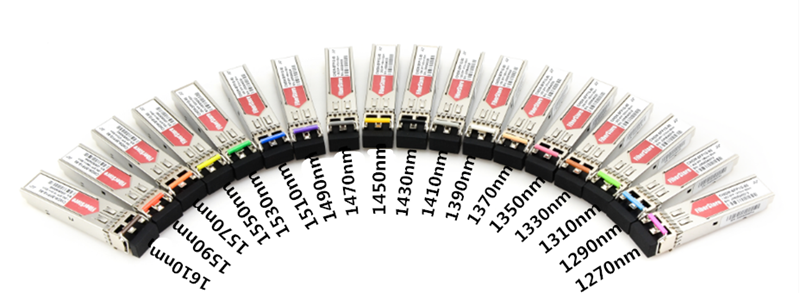
CWDM SFP+ transceiver

The second factor is the compatibility of the CWDM SFP+ transceivers. As the third party transceivers are more cost effective than the original one, the former kinds are always the choices for most users. However, the users are always unassured about the quality and compatibility of the third party transceivers for their low price. Here FS.COM is recommendable who offers the CWDM SFP+ transceivers fully tested on most famous original brand switches like Cisco, Brocade, Juniper and Arista. FS.COM CWDM SFP+ transceivers are less expensive but can perform as well as the original branded transceivers, without the compatible issue.

The third factor is the transmission distance the CWDM SFP+ transceivers can support. Although the CWDM system can not support the transmission as long as the DWDM one, it still can reach the lengths 80 km. At present, 10G CWDM SFP+ transceiver can be available at lengths of 20km, 40km, 60km, 80km or even longer on the market. Hence, you can also choose the CWDM SFP+ transceivers according to the transmission distance you system needs.

Conclusion

Building a CWDM system for carrying more data signals is a good choice if the existing network has insufficient capacity. To ensure the performance of the whole CWDM link, it is necessasry to choose the right CWDM SFP+ transceivers for the CWDM Mux Demux. From this paper, it can be concluded that there are mainly three factors, the working wavelength, the compatible issue and the transmission distance the CWDM SFP+ supports, should be taken into account when making the decision about which kind of CWDM SFP+ should be selected for the CWDM Mux Demux.

Tuesday, April 11, 2017

How to Deploy a Single-Fiber CWDM Network?

Generally, CWDM network designed for expanding the network capacity can be basically divided into two types, dual-fiber and single-fiber CWDM network, according to the optical fiber transmission line. For the dual-fiber CWDM network, its working principle is easy to acquire, which uses the same wavelength for transmitting and receiving each pair of dual-way signals over the duplex fiber cable. However, for the single-fiber CWDM network, the working principle is highly complex that specially works with different wavelengths for transmitting and receiving each pair of dual-way signals over only one fiber. To better understand the single-fiber CWDM network, here will mainly illustrate how does a single-fiber CWDM network work and introduce the components and installation steps for fast deploying a single-fiber CWDM network.

Introduction of Single-Fiber CWDM Network

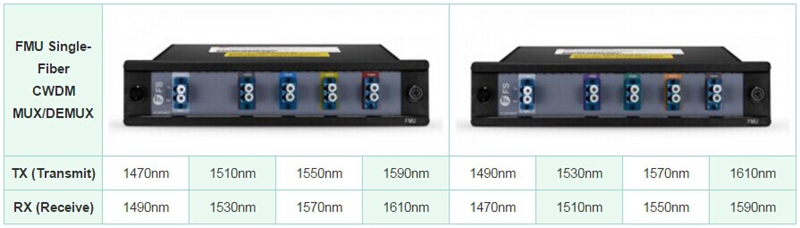
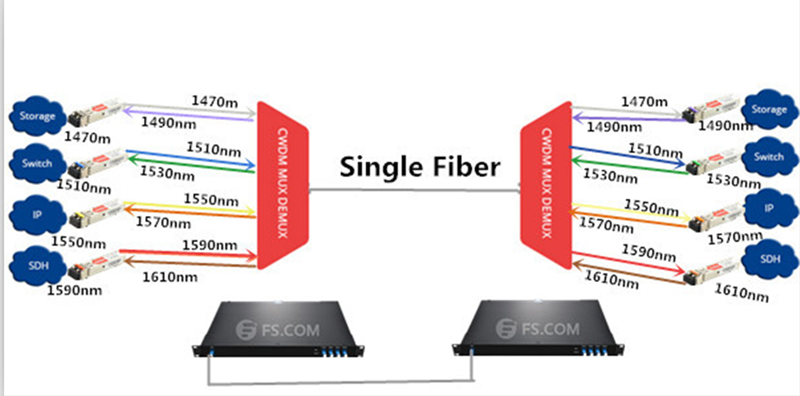
Single-fiber CWDM network is a kind of WDM network, designed for greatly expanding the network capacity by combining and transmitting several pairs of dual-way signals with different wavelengths over a single fiber, instead of putting more fibers for lager dual-way data transmission need. When the single-fiber CWDM network runs, there are two single-fiber CWDM Mux Demux using two different wavelengths for each pair of dual-way transmission. In details, if the single-fiber CWDM Mux Demux has four channels for dual-way data transmission, then eight different wavelengths divided into four pairs are required for the four channels, as shown in the figure below. To make a comparison, a 4 channel dual-fiber CWDM Mux Demux only needs four different wavelengths for the dual-way transmission.

 4 Channel CWDM Network

From the figure above, we can learn that a 4 channel CWDM network needs two reliable 4 channel CWDM Mux Demux connected by a single fiber and four pairs of CWDM transceivers with eight different wavelengths connected to the CWDM Mux Demux, achieving the dual-way transmission. Obviously, each pair of CWDM transceivers have the complete reversed TX and RX. Just taking the first pair of transceivers as example, the first transceiver on the left side uses 1470nm for TX and 1490nm for RX, while the first transceiver on the right side uses 1490nm for TX and 1470nm for RX, reversely. Meanwhile, to ensure the whole dual-way transmission, the ports of the two CWDM Mux Demux should feature the same TX and RX as those of transceivers. Hence, each pair of dual-way signals with two different wavelengths will be smoothly transmitted and received. To better understand how does the single fiber CWDM network work, the following table also lists the four pairs of wavelengths for the TX and RX ports of the two CWDM Mux Demux, which are also totally reversed.

TX and RX for Single-Fiber CWDM Mux Demux

Basic Components for a Single-Fiber CWDM Network

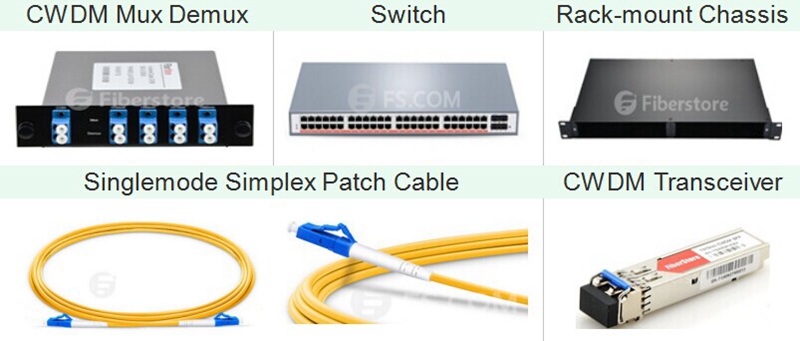
When deploy the single-fiber CWDM network, we should prepare two single-fiber CWDM Mux Demux, two switches, a rack-mount chassis, several pairs of CWDM transceivers and singlemode simplex patch cables that are the basic and essential components for a single-fiber CWDM network. The two switches separately act as the Local unit and Remote unit for the CWDM network, while the CWDM Mux Demux is the main unit of the network that should be fixed and held on the rack-mount chassis and then connected to the switch. To finish the connection between the CWDM Mux Demux and switch, we should insert the CWDM transceivers into the ports of CWDM Mux Demux and use the singlemode simplex patch cables to connect CWDM transceivers with the switch.

Basic Components for a Single-Fiber CWDM Network

Steps for Single-Fiber CWDM Network Deployment
To fast deploy a single-fiber CWDM network, here offers the step by step installation procedure.

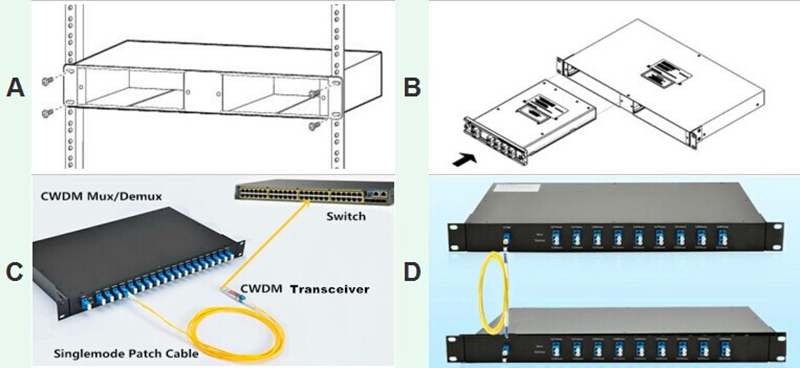
Step A: Install the rack-mount chassis in a standard 19-inch cabinet or rack.

Step B: Align the single-fiber CWDM Mux Demux with the chassis shelf, slightly push it to the shelf cavity. And tighten the captive screws once the CWDM Mux Demux is totally inserted.

Step C: Plug the CWDM transceivers into the switch. And also, connect these CWDM transceivers to the corresponding ports on CWDM Mux Demux according to the wavelengths of the TX and RX, with the use of singlemode simplex patch cable.

Step D: Utilize the singlemode simplex patch cable to connect the two CWDM Mux Demux and test the performance of the whole single-fiber CWDM network.

Installation Steps for Single-Fiber CWDM Network

Conclusion

Single-fiber CWDM network is a cost-effective and easy-to-deploy solution that can not only take full use of the available fiber bandwidth in your network but also greatly expand your network capacity. If you are hesitating over upgrading your system for bigger capacity, buy CWDM multi-channel Mux/Demux, CWDM transceivers and other basic components to deploy the single-fiber CWDM network would be a better choice for you.